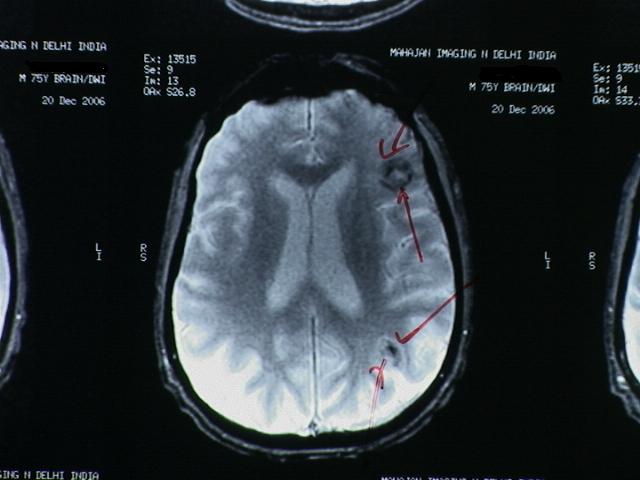
In this section we shall discuss a little about dementia. Just what do we mean when we say a person has dementia?
Dementia is a disorder in which a person has cognitive impairments in multiple domains. Meaning a patient with dementia has problems with memory ( forgets things), language ( speech gets sparse and content/ vocabulary decreases), calculation (person loses the ability to calculate: subtract, multiply etc), and abstract thinking. Depending upon what part of the brain gets affected, a patient with dementia may have personality changes and problems with executive functions like planning and other goal directed actions. They may also experience what we neurologists refer to as apraxias. Apraxia is an inability to do a learned act (example you can tie your shoe laces, it is an act you learnt as a small child. Now assume you get demented, you lose the ability to tie your shoes laces even though you are not weak and have full strength in your arms and legs). Patients with dementia may exhibit various kinds of apraxias, as the disease evolves they become dependent on care-givers for nearly all activities of daily living: cannot drive, cannot tie their shoe laces, cannot feed themselves or take a shower on their own.
There are many different types of dementia. These differ from each other in the cognitive domains affected and in the way they present clinically.
Classification of dementias:
1) Alzheimer's dementia
2) Fronto-temporal dementia also referred to as Pick's disease
3) Multi-infarct dementia also called vascular dementia
4) Dementia associated with Parkinson's disease also called Parkinson's disease dementia
5) Diffuse Lewy Body dementia
6) Primary Progressive Aphasia
7) AIDS dementia complex or HIV encephalopathy
8) Dementias associated with infections like syphilis
9) Reversible dementias like that due to hypothyroidism, deficiency of vitamin B12, thiamine (vitamin B1), hydrocephalus (normal pressure hydrocephalus)
10) Conditions which can mimic dementia example depression (pseudodementia)
Let us now discuss a few of these disorders. I shall start with the most common cause of dementia in the elderly namely Alzheimer's dementia.
Alzheimer's dementia: AD is the most common primary dementia seen in the elderly age-group. The onset of AD may be very subtle and frequently the care-givers or the patient cannot tell when did the disease first start. By the time the patients come to medical attention, the dementia is usually quite prominent. A point to note here, patients with dementia usually do not seek help by themselves. They do not feel anything is wrong with them, are not bothered by the lack of memory or their forgetfulness. It is their relatives and friends who first notice something is amiss. They notice that the patient keeps forgetting simple things, may get lost in their own neighbourhood ( for example the patient may not know what street he lives on and get lost while driving), other things like going to the grocery store and forgetting why one went there in the first place and having problems with names etc may be noticed.
Suprisingly in the earlier stages of the disease patients maintain their social graces pretty well. They may interact pretty gracefully in a social setting like a party or at work and if you are inter-acting with them casually you may never realise that they are having memory problems.
Diagnosing Alzheimer's dementia: the diagnosis of Alzheimer's disease is mostly clinical and a neurologist would be able to make the diagnosis clinically with a reasonable level of accuracy. Your doctor may order some tests like an MRI study of the brain and some blood tests to measure the thyroid hormone levels in your body, vitamin B12 level and also to rule out diseases which can mimic Alzheimer's disease in its presentation such as syphilis. Nowdays more advanced imaging tests are been used to diagnose Alzheimer's disease at an earlier stage of minimal cognitive impairment (MCI), these include PET (positron emission tomography) scan, SPECT (single photon emission computed tomography) scan and fMRI (functional MRI) scans. These facilities should be available in the big neurological centers.
Managament of Alzheimer's Dementia: Alzheimer's dementia is as of now incurable. However there are medications which can slow the progression of this neurodegenerative disease and improve the cognitive abilities of the patients. These drugs belong to a class of drug called cholinesterase inhibitors. They inhibit the cholinesterase enzyme from breaking down acetylcholine, so increasing both the level and duration of action of the neurotransmitter acetylcholine. Commonly prescribed drugs include: donepezil (Aricept), rivastigmine (Excelon), tacrine (tetrahydro aminoacridine) and galantamine. A few years ago, a new drug called memantine (Nemanda) was introduced into the market. This has a different mechanism of action as compared to the cholinesterase inhibitors. It is a NMDA receptor antagonist. Treatment with cholinesterase inhibitors does not alter the natural history of Alzheimer's dementia. Patients though do get a few more months and possibly a few more years of relatively preserved cognitive abilities. Caregiver burden is reduced and patients may remain independent in some activities of daily living. Certain other medications and nutritional supplements have been advocated for Alzheimer's disease patients with no proven efficacy. These include supplements like Ginkgo biloba and supratherapeutic doses of Vitamin E.
In the more advanced stages of the disease, patient's become mute, akinetic (do not move spontaneously), they are incontinent, cannot feed themselves and become totally dependent on caregivers. Caregiver burn out is quite common and patients may be placed in nursing homes. In this advanced stage urinary tract infections (UTI), respiratory tract infections (pneumonias) and bed sores (decubitus ulcers) are common causes of morbidity and mortality. These advanced Alzheimer's disease patients need good nursing care.
Let us talk a little about other neurodegenerative dementias. Fronto-temporal dementia also called Pick's disease resembles Alzheimer's disease except that these patients have early and more prominent frontal lobe involvement. Thus early on in the disease course, these patients have executive dysfunction (problems with planning things, thinking about future plans and how to go about making them happen). They also have prominent personality changes (may become angry, argumentative and suspicious) and also disinhibited (say whatever comes to mind, act inappropiately in social gatherings eg may start masturbating or touch themselves inappropiately). The cholinesterase inhibitors used to treat Alzhemier's dementia may also be tried in patient's with fronto-temporal dementia (Pick's disease). The name fronto-temporal dementia comes from the fact that these patients have prominent atrophy (decrease in mass or bulk or size) of the frontal and temporal poles/lobes.
Dementia of Lewy Bodies: is another type of dementia in which patient's typically exhibit fluctuating symptoms. Visual hallucinations is a prominent component of this type of dementia. Patient's respond poorly if medications like Haldol (haloperidol) are used to control their behavior. Atypical antipsychotics like Seroquel (quetiapine) are better drugs to control behavioral problems in these patients like agitation and aggression.
Dementia of Parkinson's disease: Patient's who have Parkinson disease may also develop dementia (memory problems) later on in their disease course. I shall discuss this further under Parkinson's disease.
Depression or pseudodementia: Patients who have major depression may also look as if they are demented. These patients have anhedonia (no interest in any pleasurable activity like watching TV, getting a cup of coffee, watching a movie with friends). They just sit still, may not eat if not asked too and look akinetic. These depressed patient's superfically may resemble dementia patients and hence depression is also referred to as pseudodementia. Once you treat their depression, they improve and all their "memory problems" go away.
Demented patients may have superimposed depression and vice versa hence a thorough search should be made to rule out depression in a patient with dementia as it is readily treatable.
I shall discuss depression under a separate heading. There are caretaker support groups for people who have loved ones suffering from dementia. They offer advice and help in preventing caretaker burnout.